
Natural slate: Welsh, Spanish and the rest
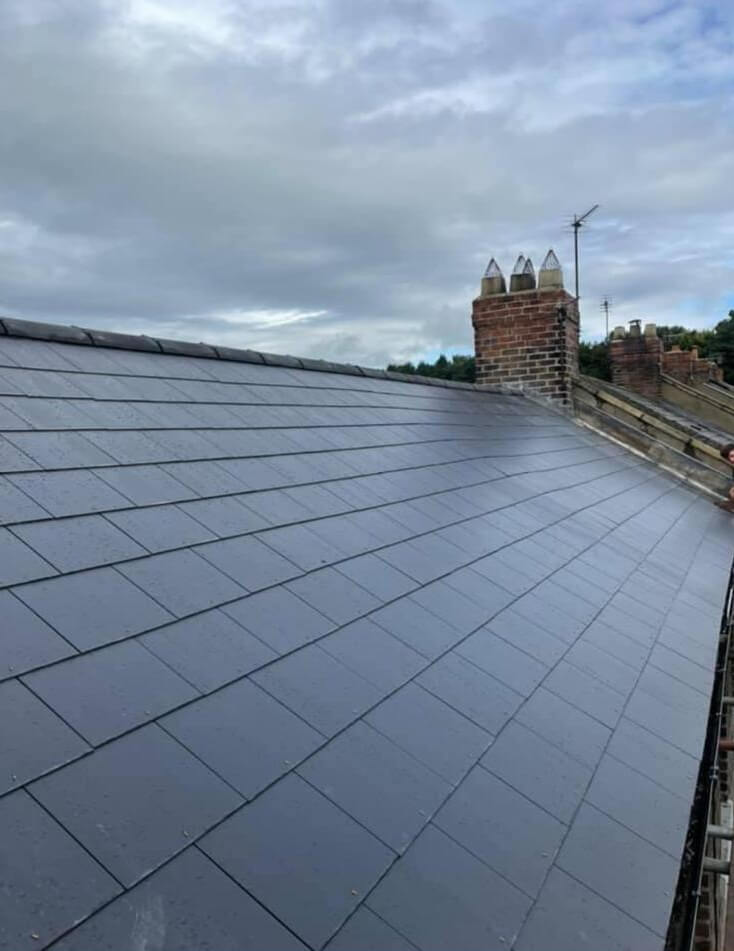
Natural slate has been covering British roofs for around 2,000 years. Properly fitted it lasts two or three human lifetimes without significant maintenance, and it is visually unmatched on pre-1920 properties and in conservation areas. We work with three main grades, each with its own properties and price point.
Welsh slate is the premium British product, quarried from a handful of active quarries in Gwynedd and Blaenau Ffestiniog. The two grades we recommend are Penrhyn (blue-grey, from the Penrhyn quarry near Bethesda, the finest slate currently available in the UK) and Cwt-y-Bugail (a slightly lighter, more riven-textured slate, excellent value for the quality). Welsh slate has extremely low water absorption (under 0.3%), excellent cleavage, and a service life genuinely measured at 100+ years.
Spanish slate, graded T1 by CE mark, comes principally from Galicia and is imported by CUPA and SSQ among others. At 60–75% of the cost of Welsh, with a 60–80 year realistic service life, it's the best-value slate on the UK market. Indistinguishable to the eye from Welsh at ground level, and the quality-control is good at CUPA Heavy 3 and SSQ Del Carmen grades.
Brazilian and Chinese slate we only fit when specifically asked. The quality variation is significant and the lifespan can be as short as 25 years on poor batches. We'll tell you honestly at quote stage if you've seen cheap slate quoted by a competitor, what you're likely to get.
Clay tiles: the right choice for many British houses
Clay is the right tile for a very large proportion of inter-war British housing. Houses built between 1880 and 1939 were originally clay-tiled (either plain tiles or pantiles), and like-for-like clay replacement looks and performs better than anything else.
We fit Marley (Acme range), Dreadnought, and Sandtoft clay tiles. Plain tiles (the small flat ones you see on most Arts and Crafts cottages and Edwardian terraces) are fitted in a triple-lap pattern — lots of tiles per square metre, labour-intensive, but arguably the most beautiful domestic roof covering available. Pantiles (the curvy S-shaped tiles you see on East Anglian and Pennine farmhouses) are fitted in a single-lap pattern, faster and cheaper than plain tiles. Clay tiles have a realistic service life of 60–100 years and a 30–50 year manufacturer warranty.
Concrete interlocking tiles
If your house was built between about 1960 and 2000, it's almost certainly concrete-tiled with either Marley Modern, Redland Cambrian, or Redland Regent interlocking tiles. These are machine-made, fast to fit, and relatively cheap — which is why they were used on most post-war British estate housing.
Concrete interlocking tiles have a 50+ year service life, 30-year manufacturer warranty, and are absolutely fine to refit like-for-like when a re-roof comes due. The one limitation: they are heavier than the original slate or clay on many 1930s houses where concrete tiles have been retrofitted, and on some older properties with questionable rafter sizing we have to go back to a lighter covering (clay or slate) on the re-roof for structural reasons. We'll tell you at quote stage.
Ridge, hip and verge detailing
The covering itself is only part of a pitched roof. The three detail edges — ridge (the line along the very top), hip (the diagonal corner where two roof slopes meet), and verge (the gable-end edge) — are where most old roofs fail first, and where the installation skill of the roofer makes most visible difference.
We fit dry ridge systems as standard on new work: mechanical-fix aluminium or plastic rails with integrated ventilation, so the ridge tiles are screwed to the roof rather than relying on mortar alone. This is the current British Standard (BS 5534, revised 2014) and it's not optional — though some cheaper installers are still quoting mortared ridges. Hip detailing follows the same principle: dry-hip systems with galvanised clips on every tile. Verge detail is either a dry-verge system (plastic unit caps, the modern spec) or traditional undercloak-and-mortar (the traditional spec, still correct on period properties in conservation areas).
Frequently asked questions
How long does a natural slate roof last?
Welsh slate: 100+ years. Spanish T1 slate: 60–80 years. Chinese/Brazilian slate: 25–50 years (we avoid).
Can I have slate on a 1960s concrete-tiled house?
Usually yes, but we need to check the rafter sizing — slate is typically heavier than the concrete tiles it would replace.
Is mortared ridge still acceptable?
No. Current British Standard BS 5534 requires mechanical fixings at ridges. Mortar alone has not been compliant since 2014.
Can you match tiles on a heritage property?
We source reclaimed tiles from local yards for conservation-area work. Matching is almost always possible — we'll confirm at quote stage.
What's the weight difference between slate and concrete tile?
Natural slate is roughly 25–35 kg/m²; concrete interlocking tile is roughly 45–55 kg/m². Slate is lighter.