
About Sandiacre
Sandiacre is recorded in the Domesday Book as Sandiacra, and its twelfth-century parish church of St Giles, on Church Street, remains one of the finest surviving Norman churches in Derbyshire. The tower and nave are largely twelfth century, and the church retains original medieval stonework that has survived nine hundred years of British weather — testament, incidentally, to how long properly-specified building materials can last.
Sandiacre's growth accelerated dramatically in the nineteenth century with the coming of the Erewash Canal (1779) and, critically, the lace-making industry. The town became one of the centres of the East Midlands lace trade, and the substantial terraced housing built for lace-factory workers still dominates the centre of town — streets like Lenton Street, Little Hallam Lane, Town Street and Derby Road have long rows of two-up two-down Victorian terraces, almost all originally roofed with Welsh slate on pitch-pine rafters with bitumen-paper felt.
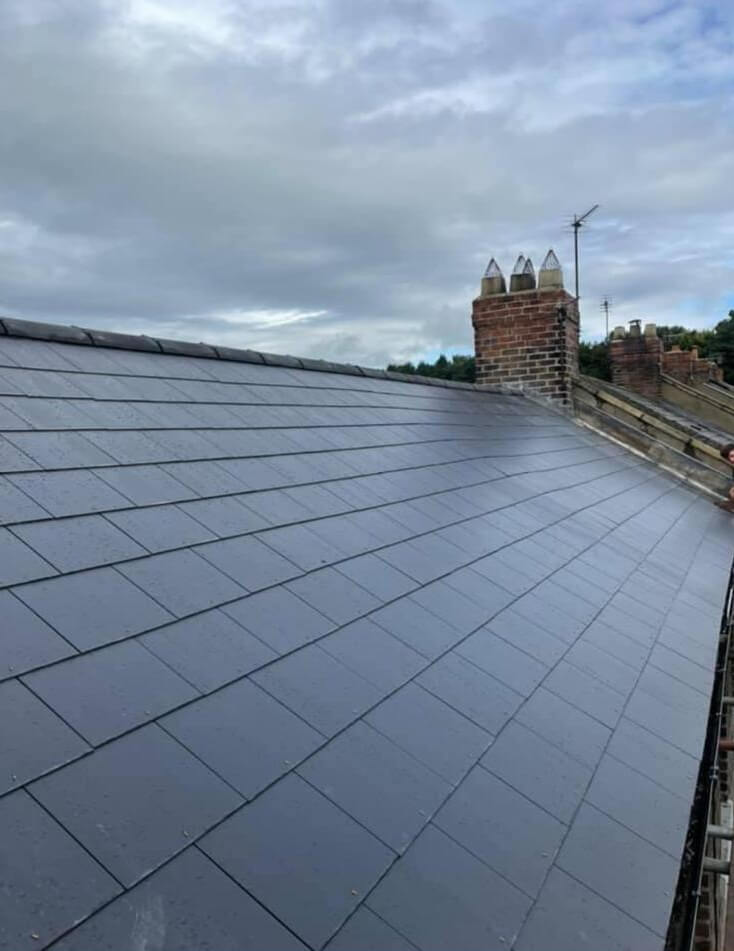
A hundred and thirty years on, that original roof spec is substantially past its reasonable service life on most Sandiacre terraces. The Welsh slate is often still serviceable and worth retaining and re-fixing on a re-roof (we work with local reclamation yards to match tiles), but the bitumen felt underneath will have failed and the battens will be due for replacement. We probably do more heritage-sensitive Victorian terrace re-roofs in Sandiacre than in any other local town.
The post-war and later private estates around the west of the town (off Station Road, Stanton Road, and the roads towards Stapleford) are mostly concrete-tiled and are reaching the 40–50 year mark where concrete tile performance starts to decline. We do a lot of slate and tile comparative quotes in Sandiacre for homeowners considering an upgrade at re-roof time.
Local roofing in Sandiacre
Recent Sandiacre work has included: full slate re-roofs on Town Street and Lenton Street; concrete tile replacement on the Stanton Road estate; multiple chimney re-pointings along Church Street; flat-roof renewals on garages off Longmoor Lane; and several Velux installations on loft conversions throughout the town.
Sandiacre is roughly 12 minutes from our Long Eaton yard. Emergency response within 30 minutes in normal working hours.
Where we work in Sandiacre
Customer reviews from Sandiacre
Full re-roof on our 1890s terrace. Kept the original slate, new breathable membrane and battens, re-laid the lot. Looks identical to how it must have looked when new. Craftsmen.
Chimney re-pointing on our Victorian end-terrace. Proper lime mortar, dressed in lead flashing, done in three days. Priced fairly and finished neatly.
Concrete tile re-roof on our 1970s semi. Everything explained clearly, quote was accurate to the penny, and they cleared up like they'd never been.
EPDM rubber on our garage. Fair price, tidy job, 20-year guarantee in writing. Exactly what we wanted.
Frequently asked questions — Sandiacre
Do you do heritage work on Sandiacre's Victorian terraces?
Yes — reclaimed Welsh slate, lime-mortar pointing, lead flashing dressed to original profile. Our bread and butter.
What if my terrace is in a conservation area?
Parts of Sandiacre around St Giles' church are in the Sandiacre Conservation Area. We handle conservation applications and advise on what will and won't get permission.
How long does a terrace re-roof take?
A typical two-storey Victorian terrace is 5–7 working days. Mid-terrace jobs sometimes benefit from combining with a neighbour for shared scaffold — ask us.
Do you cover Stanton-by-Dale village?
Yes — Stanton-by-Dale is part of our core Sandiacre coverage.
Can you source reclaimed tiles for an old roof?
We work with three local reclamation yards who stock Welsh slate, clay plain tile and pantile. Most period matches are possible.